


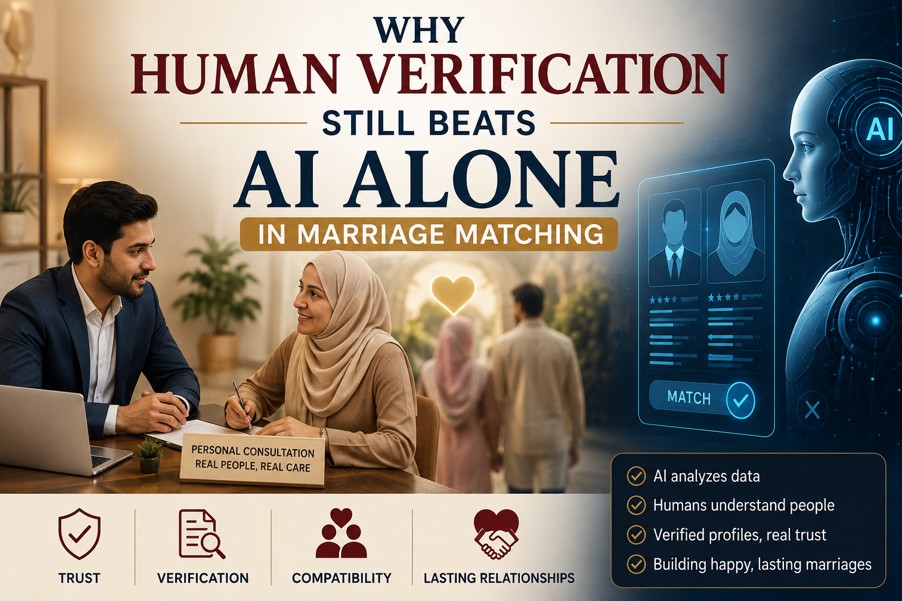
Why Human Verification Still Beats AI Alone in Marriage Matching
Finding a life partner has never been easier from a technological perspective. Artificial Intelligence (AI) can analyze thousands of profiles in seconds, compare interests, calculate compatibility scores, and recommend potential matches based on complex algorithms. In many industries, AI has transformed the way people make decisions, and the matchmaking industry is no exception.
Yet despite these technological advancements, one truth remains unchanged: marriage is not a mathematical equation. It is a lifelong commitment between two human beings, their families, values, emotions, and expectations. While AI is incredibly powerful for processing data, it cannot fully understand the nuances of human relationships.
This is why the most trusted marriage media services continue to rely on human verification alongside modern technology. AI can assist in filtering profiles, but experienced marriage consultants, family interviews, identity verification, and personal judgment still play the biggest role in creating successful marriages.
In this article, we’ll explore why human verification continues to outperform AI alone in marriage matching, especially for families seeking trustworthy, long-term relationships.
The Rise of AI in Marriage Matching
Over the past decade, AI has dramatically changed online matchmaking.
Modern matrimonial platforms now use AI to:
- Suggest compatible matches
- Analyze personality traits
- Recommend profiles based on interests
- Learn user preferences
- Detect fake accounts
- Improve search accuracy
Some apps even promise that their AI can predict relationship success by studying user behavior.
These innovations have undoubtedly made partner searching faster and more convenient.
However, convenience should never be confused with reliability.
Marriage is one of the biggest decisions a person will ever make, and no algorithm can replace human wisdom.
AI Understands Data—Humans Understand People
This is perhaps the biggest difference.
AI understands:
- Numbers
- Keywords
- Search patterns
- Online activity
- Profile similarities
Humans understand:
- Character
- Integrity
- Family values
- Emotional maturity
- Honesty
- Respect
- Cultural expectations
Two people may appear 95% compatible according to AI.
But an experienced marriage consultant might immediately recognize that:
- Their long-term goals differ.
- Their families have conflicting expectations.
- One person is not emotionally ready.
- Communication styles are incompatible.
These are things that rarely appear in data.
Human Verification Goes Beyond Profile Information
Anyone can create an online profile.
Anyone can upload attractive photos.
Anyone can describe themselves positively.
AI evaluates what people write.
Human verification evaluates whether those claims are true.
Professional marriage media often verify:
- National ID
- Passport
- Educational qualifications
- Occupation
- Income (when appropriate)
- Family background
- Marital status
- Divorce documentation
- Character references
This process creates trust that technology alone cannot guarantee.
AI Cannot Detect Hidden Intentions
One of AI’s biggest weaknesses is understanding human motivation.
For example, a profile may seem perfect.
The person may have:
- Good education
- Stable career
- Attractive photos
- Excellent compatibility score
But experienced matchmakers may discover during interviews that the individual:
- Is not serious about marriage.
- Is under family pressure.
- Has unrealistic expectations.
- Is hiding important information.
- Is seeking attention rather than commitment.
These subtle warning signs are often visible only through real conversations.
Marriage Involves Families, Not Just Individuals
In many cultures, including Bangladesh, marriage is a union of two families.
AI focuses mostly on individuals.
Human matchmakers consider:
- Family culture
- Religious practices
- Lifestyle
- Social compatibility
- Family expectations
- Respect between families
- Communication styles
These factors significantly influence long-term marital success.
Ignoring them often creates problems after marriage.
Emotional Intelligence Cannot Be Automated
Successful marriages depend heavily on emotional intelligence.
Can AI measure empathy?
Not completely.
Can AI recognize sincerity?
Not reliably.
Can AI detect kindness?
Only indirectly.
Experienced marriage consultants can often identify qualities such as:
- Patience
- Humility
- Respectfulness
- Emotional stability
- Listening ability
- Conflict management
These qualities become visible during real conversations.
Human Interviews Reveal What Algorithms Miss
Many premium marriage media conduct detailed interviews before recommending matches.
These interviews often uncover information that profiles never mention.
For example:
Someone may write:
“Flexible regarding relocation.”
During conversation, however, it becomes clear they never actually intend to move.
Similarly,
Someone may say:
“Family-oriented.”
But further discussion reveals they rarely communicate with family members.
Human interaction uncovers authenticity.
Cultural Understanding Matters
AI models are built using patterns.
But cultures are unique.
Marriage expectations differ between:
- Bangladesh
- India
- Pakistan
- Middle Eastern countries
- Europe
- North America
Even within Bangladesh, expectations differ between:
- Dhaka
- Chattogram
- Sylhet
- Rajshahi
- Rural families
- Urban professionals
Experienced local marriage consultants understand these differences naturally.
AI often treats everyone similarly.
Human Verification Reduces Fraud
Marriage fraud is unfortunately increasing worldwide.
Common issues include:
- Fake identities
- False professions
- Hidden marriages
- Financial deception
- Misrepresented age
- Edited photographs
Professional verification dramatically reduces these risks.
Human investigators often notice inconsistencies that AI overlooks.
For example:
- Conflicting employment details
- Family statements that don’t match
- Suspicious communication
- Inconsistent timelines
These investigations help protect families.
AI Cannot Replace Trust
Marriage media build their reputation through trust.
Families return because they believe:
- Profiles are genuine.
- Information is verified.
- Consultants are honest.
- Recommendations are thoughtful.
AI may provide faster recommendations.
Trust still comes from people.
Real-Life Experience Beats Pattern Recognition
Experienced matchmakers often have decades of experience.
They’ve witnessed:
- Successful marriages
- Failed relationships
- Family conflicts
- Personality mismatches
- Cultural challenges
Their decisions are based on years of observation.
AI relies on historical data.
Human experts rely on lived experience.
Every Person Has a Unique Story
No two individuals are identical.
A profile cannot fully explain:
- Childhood experiences
- Personal struggles
- Family responsibilities
- Emotional healing
- Life priorities
Human conversations reveal these stories.
Understanding someone’s journey often changes how suitable they appear as a life partner.
AI Cannot Read Silence
During interviews, experienced consultants observe more than words.
They notice:
- Hesitation
- Confidence
- Eye contact
- Respectful behavior
- Consistency
- Emotional reactions
Sometimes what a person doesn’t say is just as important as what they do.
AI cannot interpret these subtle human signals with complete accuracy.
Human Matchmakers Handle Sensitive Situations Better
Marriage discussions often involve sensitive topics such as:
- Divorce
- Widowhood
- Disability
- Financial challenges
- Health concerns
- Family disagreements
These conversations require empathy and confidentiality.
Human professionals can guide families respectfully.
AI cannot provide genuine emotional support.
Compatibility Is More Than Shared Interests

Many AI systems prioritize:
- Movies
- Music
- Travel
- Hobbies
- Food preferences
These are enjoyable but relatively small aspects of married life.
Long-term compatibility depends more on:
- Values
- Respect
- Communication
- Faith
- Financial habits
- Parenting goals
- Conflict resolution
- Emotional support
These areas require deeper human understanding.
The Role of Professional Marriage Consultants
Professional marriage consultants serve as trusted advisors.
They:
- Verify identities
- Conduct interviews
- Understand family expectations
- Recommend realistic matches
- Mediate conversations
- Maintain confidentiality
- Support both families throughout the process
Their role extends far beyond profile matching.
AI Can Be Biased
AI systems learn from existing data.
If the training data contains bias, recommendations may also become biased.
Examples include:
- Preference for certain professions
- Income-based recommendations
- Educational bias
- Geographic bias
- Age stereotypes
Human consultants can recognize these issues and make balanced decisions.
Human Verification Encourages Accountability
When people know their information will be personally verified, they are more likely to provide accurate details.
This reduces:
- False claims
- Exaggerated achievements
- Fake photos
- Hidden information
Verification creates responsibility.
Privacy Is Better Protected Through Human Judgment
Confidentiality is essential in marriage matching.
Professional consultants know:
- Which information should remain private
- When to introduce families
- How to protect personal data
- How to manage confidential conversations
Responsible human oversight helps ensure sensitive information is shared appropriately and with consent.
Why Elite Families Still Prefer Human Matchmaking
Many educated professionals and established families choose personalized marriage media services rather than relying solely on apps.
Why?
Because they value:
- Privacy
- Verification
- Trust
- Confidentiality
- Quality over quantity
- Personalized guidance
Rather than browsing hundreds of random profiles, they prefer carefully screened introductions.
The Best Approach Is AI Plus Human Expertise
This is not a competition between AI and people.
The strongest marriage services combine both.
AI excels at:
- Processing large databases
- Suggesting possible matches
- Reducing search time
- Organizing information
Human experts excel at:
- Verification
- Interviews
- Family consultation
- Relationship guidance
- Ethical judgment
- Cultural understanding
Together, they create a safer and more effective matchmaking experience.
How Trusted Marriage Media Use Technology Responsibly
Leading marriage media typically follow a balanced process:
- Collect detailed profile information.
- Verify identity and important documents.
- Conduct personal discussions with candidates.
- Understand family expectations.
- Use technology to shortlist compatible profiles.
- Review matches through experienced consultants.
- Introduce families only after careful evaluation.
- Continue offering guidance during the communication process.
This human-centered workflow provides confidence that automated matching alone cannot.
Common Myths About AI in Matchmaking
Myth 1: AI knows who your perfect partner is.
Reality: AI suggests possibilities based on available data. It cannot predict lifelong relationship success with certainty.
Myth 2: Compatibility scores guarantee happiness.
Reality: A high score does not account for trust, commitment, communication, or adaptability.
Myth 3: Human matchmakers are outdated.
Reality: Modern consultants use technology while adding judgment, empathy, and verification that software lacks.
Myth 4: More matches mean better results.
Reality: Carefully selected, verified introductions are often more valuable than hundreds of unverified recommendations.
Practical Advice for Families Seeking a Marriage Partner
Whether using an online platform or a professional marriage media, consider these best practices:
- Choose services that verify member identities.
- Be honest about your expectations and circumstances.
- Look beyond profile photos and compatibility percentages.
- Discuss values, family expectations, and life goals early.
- Take time to know the other person through respectful communication.
- Involve trusted family members or advisors when appropriate.
- Be cautious of anyone unwilling to verify important information or rushing the process.
These steps can help build a stronger foundation for a lasting relationship.
The Future of Marriage Matching
Technology will continue to improve.
AI will become better at:
- Understanding communication patterns
- Detecting fake accounts
- Improving recommendations
- Supporting personalized searches
However, the core of marriage will remain deeply human.
People seek partners who offer:
- Love
- Trust
- Respect
- Compassion
- Shared values
- Emotional security
These qualities cannot be fully measured by algorithms alone.
The future of successful matchmaking is not about replacing people with machines. It is about combining intelligent technology with experienced human guidance to create safer, more meaningful introductions.
The Human Touch: Why Personal Conversations Create Better Marriage Decisions
One of the greatest strengths of a professional marriage media is the ability to have meaningful, one-on-one conversations with prospective brides, grooms, and their families. While AI can analyze profile information in seconds, it cannot replace the value of a genuine conversation. Human interaction uncovers emotions, intentions, expectations, and personal values that rarely appear in an online profile.
For example, two candidates may both indicate that they are “family-oriented” in their profiles. To an AI system, this shared characteristic may contribute positively to a compatibility score. However, during a personal discussion, an experienced marriage consultant may discover that one person values living in a joint family, while the other hopes to establish an independent household after marriage. Although both describe themselves as family-oriented, their expectations for married life are significantly different.
Similarly, a candidate may state that they are willing to relocate after marriage. During a detailed interview, however, the consultant may learn that this willingness depends on career opportunities, parental responsibilities, or specific geographic preferences. These subtle details can have a major impact on marital compatibility, yet they are difficult for an algorithm to interpret without direct human involvement.
This is why experienced marriage consultants spend time understanding each individual beyond the written profile. They ask thoughtful questions, observe communication styles, and gain a deeper understanding of the person’s priorities. These conversations help identify compatible matches that are based not only on data but also on real-life expectations.
Why Reputation Matters More Than Technology
Technology evolves rapidly. Today’s most advanced AI system may become outdated within a few years. However, the reputation of a trusted marriage media is built over decades through honesty, successful matches, and satisfied families.
Families often choose an established marriage media because they value credibility. They want to know that the organization has experience handling confidential information, verifying profiles, and introducing families responsibly. This level of trust cannot be created by software alone.
A reputable marriage media develops relationships with clients through consistent service. Consultants remember family preferences, understand cultural traditions, and provide guidance based on years of practical experience. Their reputation becomes a valuable asset that reassures new clients.
In contrast, an AI platform may recommend thousands of profiles without any accountability if a match turns out to be misleading. Human professionals, on the other hand, take responsibility for maintaining the quality of introductions and protecting the trust placed in them by families.
Balancing Technology with Ethics
As AI becomes more powerful, ethical considerations become increasingly important. Marriage matching involves highly personal information, including family background, education, profession, financial status, religious beliefs, and future life goals. Managing this information requires not only technical security but also ethical responsibility.
Human professionals understand when certain information should remain confidential and when it is appropriate to share details with another family. They recognize that every client deserves privacy and dignity throughout the matchmaking process.
Ethical matchmaking also means avoiding unnecessary pressure. A responsible marriage consultant will never encourage a family to proceed with a proposal simply because the compatibility score is high. Instead, they provide balanced advice, allowing both individuals and families to make informed decisions at their own pace.
AI systems can process data efficiently, but they cannot exercise moral judgment. Ethical decision-making remains one of the strongest reasons why human involvement is indispensable in marriage matching.
Successful Marriages Depend on Communication, Not Algorithms
Every successful marriage is built on communication. Couples who openly discuss expectations, responsibilities, finances, personal goals, and family relationships are generally better prepared for married life.
Professional marriage consultants often encourage these conversations before a formal commitment is made. They help both parties ask important questions that might otherwise be overlooked.
Some of these discussions include:
- Career ambitions after marriage
- Financial planning and budgeting
- Expectations regarding children
- Family responsibilities
- Religious practices
- Lifestyle preferences
- Long-term life goals
- Communication during disagreements
These conversations help couples understand each other more deeply before making one of the biggest decisions of their lives.
An AI platform may recommend a compatible profile, but it cannot facilitate these meaningful discussions with the empathy and flexibility that experienced professionals provide.
Human Verification Creates Long-Term Confidence
Marriage is intended to be a lifelong partnership. Therefore, confidence in the information shared during the matchmaking process is extremely important.
When profiles are carefully verified by experienced professionals, families feel more secure moving forward. They know that basic information such as educational qualifications, employment details, marital status, and identity has been checked with reasonable care.
This confidence reduces unnecessary anxiety and allows both families to focus on building a genuine relationship rather than worrying about hidden surprises.
Trust established at the beginning of the marriage process often contributes to healthier communication between families throughout the engagement and beyond.
AI Is a Powerful Assistant—Not a Complete Matchmaker
The future of marriage matching does not lie in choosing between artificial intelligence and human expertise. Instead, it lies in combining both effectively.
AI is exceptionally good at organizing large databases, identifying potential compatibility patterns, and helping users discover suitable profiles more efficiently. These capabilities save time and make the search process more convenient.
However, once promising matches have been identified, human expertise becomes essential. Professional consultants verify important information, understand emotional dynamics, evaluate family compatibility, and provide personalized guidance throughout the journey.
In this balanced approach, AI acts as a valuable assistant rather than the final decision-maker.
The most successful marriage media recognize that technology should enhance human judgment—not replace it.
Final Thoughts
Artificial Intelligence has undoubtedly transformed modern matchmaking by making profile searches faster, smarter, and more efficient. Yet the qualities that build a successful marriage—trust, honesty, empathy, commitment, respect, and shared values—remain deeply human.
A compatibility score may introduce two people, but only careful verification, thoughtful conversations, and experienced guidance can determine whether they are truly ready to build a life together.
For this reason, families seeking serious, long-term relationships continue to place their confidence in marriage media that combine advanced technology with experienced human verification. This balanced approach offers the best of both worlds: the efficiency of AI and the wisdom of human understanding.
Conclusion
Artificial Intelligence has undoubtedly transformed the marriage matching industry by making profile searches faster, smarter, and more efficient. It helps users discover potential partners based on shared interests, preferences, and behavioral patterns, saving valuable time in the search process.
Yet marriage is far more complex than data points and compatibility percentages. A successful relationship depends on honesty, emotional maturity, family values, mutual respect, communication, and trust—qualities that are difficult for algorithms to evaluate accurately on their own.
Human verification adds a critical layer of confidence by confirming identities, validating important information, understanding personal motivations, recognizing emotional nuances, and guiding families through one of life’s most significant decisions. Experienced marriage consultants bring cultural awareness, empathy, discretion, and practical judgment that technology cannot fully replicate.
The most reliable approach is not choosing between AI and human expertise but combining the strengths of both. AI can efficiently narrow the search, while human professionals ensure authenticity, safety, and meaningful compatibility. Together, they create a matchmaking process that is smarter, more trustworthy, and better suited to building lasting marriages.