


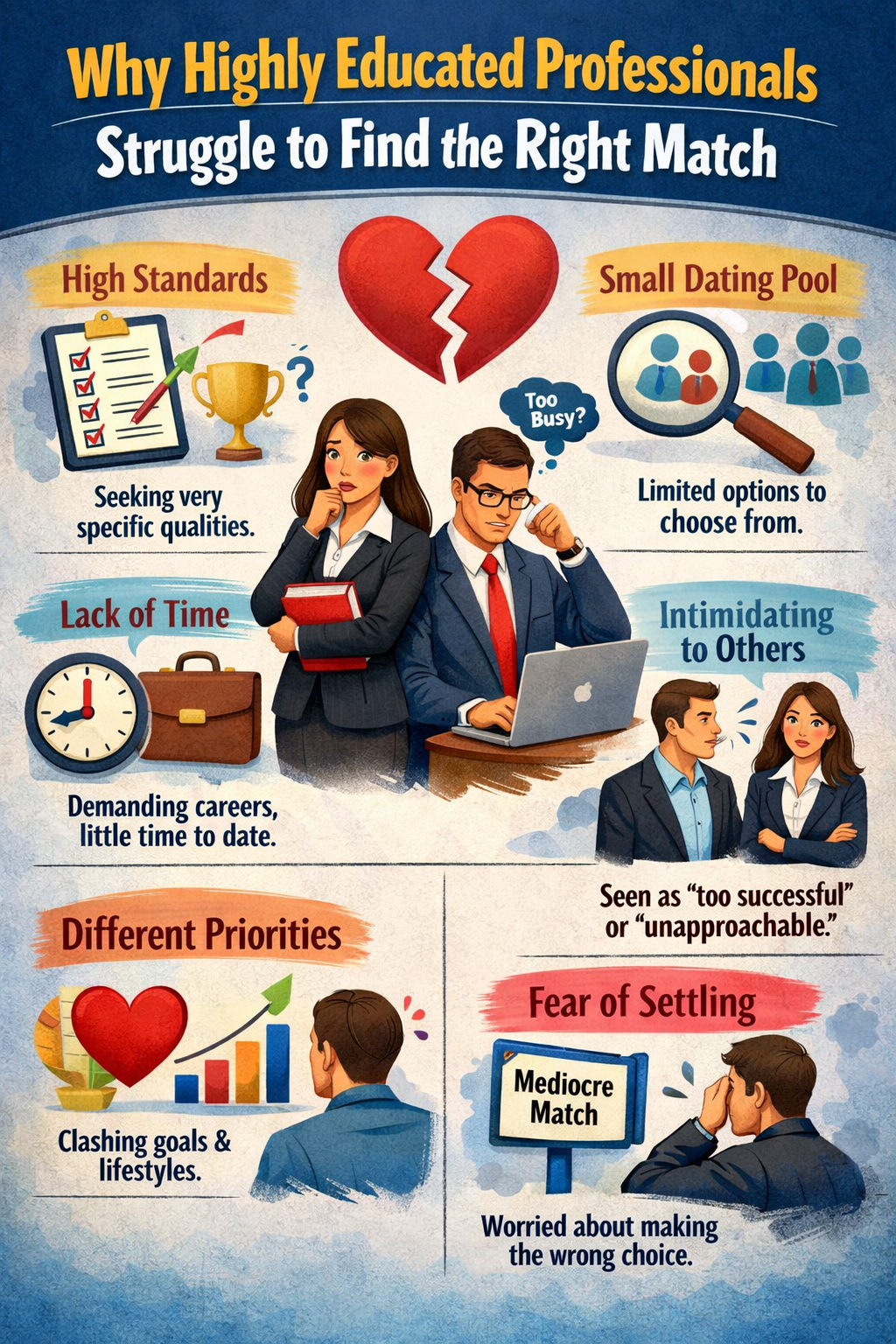
Why Highly Educated Professionals Struggle to Find the Right Match
In Dhanmondi, Gulshan, Banani — in offices filled with glass walls and ambition — you’ll find men and women who have done everything “right.”
They studied hard.
They earned degrees from reputed universities.
Some went abroad.
Some built startups.
Some climbed corporate ladders before turning thirty-five.
On paper, they are impressive.
Yet behind closed doors, in quiet family conversations, one question keeps returning:
“Why is it still so hard to find the right person?”
It’s a question KabinBD hears almost every week.
Because the truth is — success in education and career does not automatically translate into success in choosing a life partner. In fact, sometimes it makes it harder.
Let’s talk about why.
The Paradox of Having Too Many Choices
Highly educated professionals are trained to analyze.
To compare.
To evaluate risk.
To avoid wrong decisions.
That mindset builds careers.
But marriage is not a corporate merger.
Many professionals approach marriage like a project:
- Compare qualifications
- Assess family background
- Evaluate lifestyle compatibility
- Calculate financial parity
- Check long-term potential
On paper, this sounds logical. Responsible, even.
But something subtle happens.
The more educated someone becomes, the more refined their expectations grow. And with every added criterion, the pool becomes smaller.
Suddenly, it’s not just:
- Good character
- Respectful family
- Stable career
It becomes:
- Must have similar academic background
- Must earn close to or more than me
- Must match my lifestyle
- Must think progressively
- Must respect tradition but not be “too traditional”
- Must be ambitious but not “too career-obsessed”
And quietly, the list becomes nearly impossible.
Not because such people don’t exist.
But because human beings are complex — not checklists.
Emotional Intelligence vs Academic Intelligence
One uncomfortable truth rarely discussed openly:
Academic excellence does not guarantee emotional maturity.
Many high achievers grew up focusing heavily on results — grades, performance, recognition.
They learned:
- How to compete
- How to outperform
- How to achieve
But not always:
- How to compromise
- How to communicate vulnerability
- How to handle emotional uncertainty
Marriage requires emotional flexibility. It requires accepting imperfection — in yourself and in someone else.
Yet perfectionism often follows educated professionals like a shadow.
They fear:
- Making the wrong choice
- Settling too soon
- Choosing someone “less”
- Losing independence
And so, they wait.
And wait.
And wait.
The Fear of “Settling”
Among Dhaka’s educated class, especially in areas like Dhanmondi, the fear of “settling” is powerful.
Settling for:
- Someone less educated
- Someone from a different social exposure
- Someone with a simpler ambition
- Someone not “impressive” enough
But here’s the irony.
The longer one waits for perfection, the harder it becomes to feel satisfied with reality.
Because real relationships are built — not optimized.
KabinBD often meets clients who say:
“I just haven’t found someone at my level.”
But when asked what “my level” means, the answer is often unclear.
Level in what?
Income?
Education?
Exposure?
Ego?
Sometimes, what they’re actually seeking is emotional safety — but they frame it as status compatibility.
Independence Can Become Isolation
Education gives independence.
Financial stability gives confidence.
Urban living gives freedom.
But independence can slowly turn into self-sufficiency.
And self-sufficiency can quietly become isolation.
When someone lives alone for many years:
- They develop fixed routines
- They grow used to decision-making autonomy
- They become comfortable without compromise
Marriage disrupts patterns.
Suddenly:
- You cannot always choose the restaurant
- You cannot always prioritize work
- You cannot always control your schedule
For someone deeply used to autonomy, this feels threatening — even if they truly desire companionship.
So subconsciously, they resist.
Social Circles Shrink After 30
Another reality few acknowledge:
The older you get, the smaller your organic meeting circle becomes.
University life offered:
- Classmates
- Social gatherings
- Shared growth
But after 30:
- Work dominates
- Friends get married
- Social events reduce
Highly educated professionals often work in specialized fields with limited exposure to diverse social circles.
They meet colleagues — not potential partners.
And dating apps?
Many professionals feel:
- They lack seriousness
- Profiles feel superficial
- Privacy feels compromised
This is why professional marriage media like KabinBD have become increasingly relevant — because structured, verified introductions feel safer and more aligned with family values.
The Pressure of Equal Matching
In many families, there is silent pressure:
“If she has a Master’s from abroad, he must too.”
“If he earns in six figures, she must match the lifestyle.”
Equality sounds progressive.
But equality defined only by degrees and income can overshadow compatibility.
Sometimes two equally accomplished individuals struggle because:
- Both are dominant decision-makers
- Both prioritize career above relationship
- Both struggle to compromise
- Both fear vulnerability
Education creates strong personalities.
Strong personalities need emotional humility to coexist peacefully.
Without that, even “perfect matches” feel exhausting.
Trauma of High Expectations
Educated professionals often carry another invisible burden:
Family expectations.
Parents invested:
- Money
- Pride
- Sacrifice
Now marriage becomes another performance milestone.
The match must reflect family status.
So the search becomes heavier.
And every rejected proposal feels like:
- Time wasted
- Social embarrassment
- Emotional fatigue
After several unsuccessful meetings, many professionals grow cynical.
They begin assuming:
“Maybe there’s no one suitable left.”
But often, it’s not scarcity.
It’s emotional exhaustion.
Overanalysis Kills Natural Connection
Professionals are trained problem-solvers.
But marriage isn’t a problem to solve.
It’s a connection to nurture.
Sometimes, two people meet and instead of feeling the conversation, they mentally evaluate:
- “Does this align with my five-year plan?”
- “What about relocation options?”
- “Is her communication style aligned with mine?”
Analysis is useful.
But chemistry cannot be fully analyzed.
And sometimes, the right person is not the most impressive person — but the one who feels peaceful.
Peace is underrated in modern matchmaking
 .
.
The Illusion of “More Time”
Many educated professionals believe:
“I can marry anytime.”
Career feels urgent.
Marriage feels flexible.
But biology, social timing, emotional readiness — they all have natural rhythms.
By mid-thirties, something shifts.
Options narrow — not because quality decreases, but because life paths become more defined.
The more defined two lives become separately, the harder they are to merge.
The Ego Factor
Education builds identity.
Identity builds pride.
Pride can build ego.
And ego quietly blocks compatibility.
Simple scenarios become complicated:
- Who compromises location?
- Whose career takes priority after children?
- Whose family norms dominate?
When both individuals strongly protect their autonomy, marriage negotiations become power negotiations.
And no one wins.
So What Actually Works?
After working with hundreds of educated professionals, one pattern becomes clear.
The ones who find lasting compatibility usually:
- Shift from perfection to partnership
- Value character over credentials
- Accept minor lifestyle differences
- Communicate openly about fears
- Remain flexible in expectations
They don’t lower standards.
They refine them.
Instead of asking:
“Is this person impressive enough?”
They ask:
“Can I feel emotionally safe with this person?”
That one shift changes everything.
Why Professional Matchmaking Helps
In Dhaka’s evolving marriage culture, especially among educated families, structured guidance matters.
Because when expectations are high, emotional mediation becomes important.
A professional platform like KabinBD helps by:
- Verifying backgrounds
- Aligning family expectations early
- Encouraging realistic discussions
- Filtering based on values, not just degrees
- Protecting privacy
It creates space for serious individuals who are ready — not just browsing.
And sometimes, readiness matters more than perfection.
The Quiet Truth No One Says Out Loud
Highly educated professionals don’t struggle because they are “too qualified.”
They struggle because:
- They fear vulnerability.
- They fear regret.
- They fear losing independence.
- They fear choosing wrong in a society that remembers mistakes.
But love — whether arranged or chosen — always carries risk.
Education teaches us to minimize risk.
Marriage teaches us to embrace uncertainty.
And perhaps the right match isn’t the one who meets every condition.
But the one who feels like home in a world of constant achievement.
Final Reflection
If you are a highly educated professional reading this and wondering why the process feels harder than it should — know this:
You are not alone.
And the solution is not lowering your worth.
It’s softening your rigidity.
Compatibility is not about matching CVs.
It’s about matching values, temperament, and long-term vision.
Sometimes, the right person is not the most accomplished person in the room.
But the one who makes your life lighter.
And that is something no degree can measure.
Absolutely. Let’s go deeper.
Because the struggle of highly educated professionals in finding the right match isn’t just about standards or timing. It’s layered. It’s psychological. It’s cultural. And in cities like Dhaka — especially among Dhanmondi’s educated circles — it’s becoming more visible than ever.
Here’s the continuation.
Why Highly Educated Professionals Struggle to Find the Right Match (Part 2)
When Intelligence Becomes a Defense Mechanism
Highly educated individuals are often excellent at reasoning.
But reasoning can quietly become a shield.
Instead of saying:
“I’m scared this won’t work.”
They say:
“Our long-term compatibility index seems weak.”
Instead of admitting:
“I feel vulnerable.”
They say:
“I need more time to evaluate.”
Intellectualization is comfortable. It feels safe. It avoids emotional exposure.
But marriage requires emotional risk.
Sometimes, the more intelligent a person is, the more skilled they are at protecting themselves from emotional uncertainty. They can rationalize walking away from something that might have worked — simply because it wasn’t perfectly aligned.
And perfection rarely exists in human relationships.
The Comparison Trap in Elite Circles
In highly educated communities, comparison is subtle but constant.
Who married whom.
Who married “better.”
Who went abroad.
Whose spouse earns more.
Whose wedding looked more prestigious.
Social comparison doesn’t just happen on social media. It happens at family gatherings, alumni events, corporate parties.
This environment creates pressure to “match upward.”
Even when someone meets a kind, emotionally stable person — they may hesitate if that person doesn’t fit the social prestige narrative.
The tragedy?
Prestige doesn’t guarantee peace.
And many professionals secretly admit later:
“I chose status. I should have chosen stability.”
But fear of judgment often overrides inner clarity.
When Career Identity Becomes the Whole Identity
Highly educated professionals often invest 10–15 years building one thing: their career identity.
Doctor.
Engineer.
Corporate executive.
Entrepreneur.
Researcher.
Consultant.
That title becomes central to self-worth.
Now imagine merging that identity with someone else’s.
Marriage demands that career be part of life — not the entire life.
But for some professionals, stepping back even slightly feels like losing ground.
Questions arise:
- If I relocate for my spouse, will I fall behind?
- If I prioritize family, will I lose my competitive edge?
- If my partner earns less, will I carry more pressure?
These are real concerns. Not shallow ones.
But when career becomes non-negotiable, marriage becomes conditional.
And conditional love rarely feels secure.
The Hidden Loneliness of High Achievement
There’s something rarely discussed openly:
Success can be isolating.
Highly educated individuals often outgrow their early social circles. Their lifestyle changes. Their priorities shift.
But success doesn’t automatically build deep emotional companionship.
Many professionals come home to:
- Empty apartments
- Silent evenings
- Work emails instead of conversations
Yet when a suitable proposal comes, fear appears:
“What if I lose my peace?”
“What if this complicates my life?”
It’s a strange paradox.
They crave companionship.
But fear disruption.
And because their lives are already structured and stable, they hesitate to introduce emotional unpredictability.
The Problem of Emotional Burnout
By the time many professionals actively search for marriage — they’re already exhausted.
Exhausted from:
- Career pressure
- Family expectations
- Social comparison
- Repeated proposal meetings
Each meeting becomes an interview.
Each conversation feels rehearsed.
After 6–8 unsuccessful attempts, enthusiasm fades.
They stop investing emotionally.
They become guarded.
They approach meetings mechanically.
And when emotional energy is low, even a good match may not spark connection.
It’s not incompatibility.
It’s burnout.
When Both Partners Are “Too Busy”
Modern educated couples often share one common trait: ambition.
Ambition is attractive.
But two highly ambitious individuals must consciously design space for intimacy.
Without intentional effort, the relationship becomes:
- Calendar coordination
- Logistics planning
- Task division
Romance gets postponed.
Emotional conversations get delayed.
Both are successful. Both are intelligent. But neither slows down enough to nurture the bond.
And slowly, distance forms — even before marriage happens.
This fear makes some professionals overly cautious before committing.
They’ve seen ambitious marriages struggle.
So they over-screen.
They over-evaluate.
They delay.
The Myth of Perfect Compatibility
Highly educated individuals often believe in optimized compatibility.
Shared education.
Shared travel exposure.
Shared worldview.
Shared intellectual interests.
While alignment matters, total similarity can also reduce growth.
Sometimes the right partner challenges you.
Balances you.
Softens your intensity.
But when someone feels “different,” professionals may interpret it as incompatibility instead of complementarity.
For example:
- One is analytical, the other intuitive.
- One is highly social, the other reserved.
- One is structured, the other spontaneous.
Instead of asking, “Can this balance us?” they ask, “Is this mismatch?”
And promising dynamics are dismissed too early.
Family Expectations in Educated Households
In educated families, expectations are rarely loud — but they are heavy.
Parents who invested in education expect an equally “worthy” match.
They may not say it directly.
But phrases like:
“We want someone suitable.”
“She should match your status.”
“He should be at least equal.”
These statements shape decision-making.
Sometimes the individual likes someone.
But worries:
“Will my family think this is below our standard?”
So they let go.
Not because of incompatibility.
But because of imagined judgment.
Fear of Divorce in Elite Communities
Among educated professionals, divorce carries a unique stigma.
Because the marriage was supposed to be “well thought out.”
So they become extremely cautious before committing.
They analyze red flags deeply.
They question small behavioral inconsistencies.
They interpret minor differences as future risks.
Caution is wise.
But hyper-vigilance kills spontaneity.
No human being is completely risk-free.
And sometimes, fear of future failure prevents present commitment.
Emotional Vulnerability Is Harder for High Performers
High performers are used to competence.
They are used to being admired.
Marriage requires moments of weakness.
Crying.
Admitting insecurity.
Sharing fear.
Accepting flaws.
For someone always seen as “strong,” vulnerability feels uncomfortable.
They may struggle to express affection naturally.
They may struggle to admit attachment.
And potential partners may interpret this as coldness or lack of interest.
But often, it’s just emotional inexperience.
Gender-Specific Challenges
For Highly Educated Women
In Dhaka’s elite circles, highly accomplished women face unique dilemmas:
- Some men feel intimidated.
- Some families expect them to downplay ambition.
- Some proposals assume they will eventually prioritize family over career.
This creates internal conflict.
Should she shrink to be acceptable?
Should she demand full equality?
Will marriage slow her growth?
Many delay marriage not because they can’t find proposals — but because they can’t find emotional safety alongside respect.
For Highly Educated Men
Men also face pressure.
If they are financially strong and highly educated:
- Families expect them to choose someone “perfect.”
- They may feel pressure to be primary providers, even if the spouse earns well.
- They may struggle with partners who are equally dominant.
Some fear emotional confrontation.
Some avoid strong-willed partners.
Some unintentionally seek admiration rather than partnership.
And that imbalance later creates tension.
The Role of Structured Matchmaking
This is where professional marriage media becomes valuable.
Not because people cannot find matches independently.
But because educated professionals need:
- Filtered seriousness
- Background verification
- Family alignment
- Discretion
- Mediation during expectation mismatch
KabinBD, for example, often notices that once expectations are clarified early — emotional clarity increases.
When both families understand:
- Career priorities
- Relocation possibilities
- Lifestyle expectations
- Financial mindset
The confusion reduces.
And connection has space to grow.
A Subtle But Powerful Shift
The professionals who eventually find fulfilling partnerships often experience one internal shift.
They stop asking:
“Is this person perfect?”
And start asking:
“Can we build something meaningful together?”
That shift transforms the search.
They become less defensive.
More curious.
More open.
They still value education.
They still respect ambition.
But they no longer treat marriage as a performance decision.
They treat it as a human decision.
The Truth About Timing
There is no “perfect age.”
But there is emotional timing.
Some professionals delay marriage waiting for:
- More savings
- More stability
- A promotion
- A property purchase
But emotional readiness doesn’t always align with financial milestones.
Sometimes, waiting for total stability creates emotional distance from vulnerability.
Marriage is not the end of ambition.
It’s a parallel journey.
And many successful couples grow faster together than alone.
Final Reflection (Extended)
Highly educated professionals struggle not because they are flawed.
They struggle because:
They think deeply.
They feel pressure intensely.
They fear mistakes seriously.
They value independence strongly.
But love is not an academic thesis.
It’s not a corporate acquisition.
It’s not a strategic alliance.
It’s a decision to grow with someone imperfect — while being imperfect yourself.
In Dhaka’s evolving marriage culture, especially among educated families in Dhanmondi and surrounding areas, the definition of “right match” is slowly changing.
It is no longer just about:
Degree + Salary + Family Status.
It is about:
Emotional safety.
Mutual respect.
Flexibility.
Shared long-term direction.
Kindness under stress.
And perhaps the real challenge for highly educated professionals is this:
Learning that intelligence should guide marriage — not control it.
Because sometimes the most intelligent decision…
is choosing with both mind and heart.