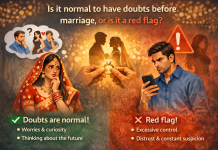


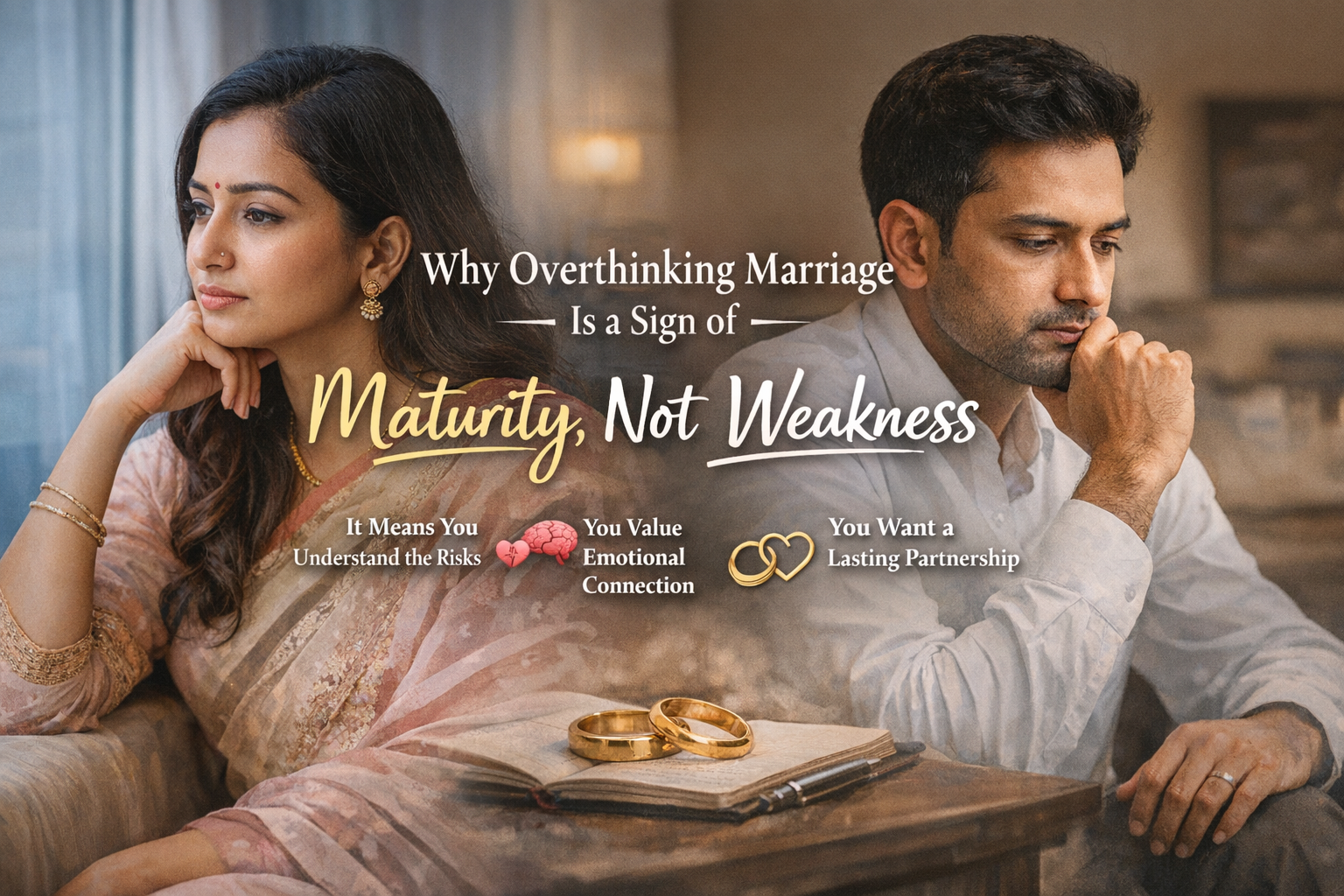
Why Overthinking Marriage Is a Sign of Maturity, Not Weakness
In Bangladesh, there is a quiet accusation that follows many educated, thoughtful men and women once they cross a certain age:
“You think too much.”
“Marriage doesn’t need this much analysis.”
“People got married with less and survived.”
And slowly, overthinking becomes framed as a flaw.
A delay tactic.
A fear response.
A sign that something is wrong.
But here’s the truth no one says out loud:
Overthinking marriage is often not immaturity.
It is the clearest sign that someone understands what marriage actually costs.
The Myth: Confident People Decide Fast
We love stories of certainty.
Someone meets a proposal.
Feels a “click.”
Everything feels easy.
Families agree.
Marriage happens smoothly.
So when someone hesitates, asks questions, or needs time, we assume:
- They’re emotionally unavailable
- They’re scared of commitment
- They want perfection
- They don’t know what they want
But real life isn’t a movie.
In reality, the people who rush are often not confident—they’re untested.
They haven’t yet asked:
- Can I live with this person when attraction fades?
- Can we survive conflict without turning cruel?
- What happens when expectations clash with reality?
Overthinkers ask these questions not because they are weak—
but because they are aware.
Awareness Changes the Way You Approach Marriage
There was a time when marriage was mostly about survival:
- Financial security
- Social acceptance
- Family continuation
Today, marriage is expected to deliver:
- Emotional safety
- Friendship
- Growth
- Sexual compatibility
- Mutual respect
- Shared values
- Stability in uncertainty
That’s a lot to ask from one human being.
So when someone pauses before choosing a life partner, it often means:
“I know what marriage demands—and I don’t want to enter blindly.”
That’s not fear.
That’s responsibility.
Overthinking Is Often the Result of Experience
Many people who overthink marriage didn’t start that way.
They became thoughtful because they:
- Saw unhappy marriages up close
- Witnessed silent suffering in “successful” couples
- Watched strong people lose themselves after marriage
- Experienced emotional manipulation in past relationships
They learned that:
- Love alone doesn’t protect you
- Good intentions don’t prevent damage
- Compatibility doesn’t reveal itself on paper
So now, they pause.
Not because they want less—but because they want better.
The Real Fear Isn’t Marriage—It’s Irreversible Damage
Overthinkers are not afraid of marriage.
They are afraid of:
- Being lonely inside a marriage
- Losing self-respect slowly
- Being misunderstood for years
- Living a life that looks fine but feels empty
Divorce is not the only failure.
A long, emotionally dead marriage is also a loss—just a quieter one.
When someone takes time before saying yes, they are often trying to avoid long-term regret, not short-term discomfort.
Why Society Pressures Thoughtful People More
Interestingly, society rarely pressures careless people.
The pressure always falls on:
- The emotionally intelligent daughter
- The financially stable son
- The responsible eldest child
- The one who “thinks deeply”
Why?
Because families trust them to adjust.
They assume:
“You’ll manage.”
“You’ll compromise.”
“You’re mature—you’ll figure it out.”
So when these same people hesitate, it creates discomfort.
Their overthinking forces everyone else to confront a scary question:
What if marriage isn’t automatically safe?
And instead of addressing that fear, society labels the thinker as the problem.
Overthinking vs Avoidance: The Difference Matters
Not all hesitation is the same.
There is a difference between:
- Avoidance (running from responsibility)
- Reflection (understanding responsibility)
Avoidance sounds like:
- “I’ll never be ready.”
- “Everyone is problematic.”
- “I don’t believe in marriage.”
Reflection sounds like:
- “I need clarity before commitment.”
- “I want to understand what I’m stepping into.”
- “I don’t want to repeat patterns I’ve seen.”
One avoids life.
The other prepares for it.
KabinBD often sees this difference firsthand—people who genuinely want marriage but refuse to treat it casually.
Why Quick Decisions Are Often Romanticized
Fast decisions feel romantic because they look confident.
But confidence without information is just hope wearing a suit.
Many rushed marriages work—not because they were rushed—but because both people later worked hard to fix what they didn’t consider earlier.
But many others don’t.
And those failures rarely announce themselves loudly.
They show up as:
- Emotional distance
- Chronic misunderstanding
- Silent resentment
- Parallel lives under one roof
Overthinkers aren’t immune to failure—but they reduce unnecessary risk.
Maturity Is Knowing What You Can and Cannot Compromise On
Immaturity says:
“Love will solve everything.”
Maturity says:
“Some differences grow louder with time.”
Overthinking helps people identify:
- Which values are non-negotiable
- Which habits are tolerable
- Which traits become dangerous under stress
It’s not about finding perfection.
It’s about avoiding predictable pain.
That discernment doesn’t come from fear.
It comes from self-knowledge.
Why Overthinkers Often Make Better Partners
When thoughtful people finally commit, they tend to:
- Communicate better
- Take responsibility seriously
- Respect boundaries
- Understand emotional impact
- Choose intentionally, not impulsively
They don’t enter marriage to be saved.
They enter to build something stable.
And once they say yes—it’s rarely casual.
What Families Should Understand
If your son or daughter is thinking deeply about marriage, it doesn’t mean:
- They don’t value family
- They are influenced negatively
- They are becoming “too modern”
It often means:
- They understand consequences
- They want to protect everyone involved
- They don’t want a marriage that survives only socially
Pressure may produce a wedding.
But clarity produces a marriage.
How KabinBD Supports Thoughtful Decisions
At KabinBD, we see overthinking not as a delay—but as a process.
That’s why:
- We prioritize verified information
- We encourage real conversations
- We allow space for reflection
- We respect families who want clarity, not speed
Marriage is not a race.
It’s a permanent partnership.
And thoughtful people deserve a system that matches their depth—not rushes them past it.
Final Thought
If you are overthinking marriage, pause before judging yourself.
Why Overthinking Marriage Is a Sign of Maturity, Not Weakness(Extended)
The Loneliness of the Thoughtful Person
One of the hardest parts of overthinking marriage is that it’s a lonely position.
People who think deeply rarely find many others who think the same way. Around them, they see:
- Friends getting married “because it was time”
- Cousins agreeing because “the family liked the proposal”
- Colleagues settling because “nothing was wrong enough to say no”
And slowly, the overthinker starts to feel like the odd one out.
They attend weddings smiling, while a quiet voice inside asks:
“Am I broken for not feeling ready?”
But loneliness doesn’t mean you’re wrong.
It often means you’re walking ahead of the crowd.
When Logic and Emotion Refuse to Align
Overthinking marriage is rarely a purely logical process.
In fact, it’s exhausting precisely because logic and emotion don’t always agree.
Logically, the proposal may look fine:
- Educated
- Respectable family
- Stable income
- No visible red flags
Emotionally, something feels… muted.
Not wrong.
Just incomplete.
This mismatch creates inner conflict. And instead of listening to it, society tells people to suppress it:
“Feelings will grow later.”
“Love comes after marriage.”
“You’re expecting too much.”
Sometimes, those statements are true.
But sometimes, they silence intuition—the very instinct that protects people from years of quiet dissatisfaction.
Maturity is not ignoring discomfort.
It’s being brave enough to explore it.
The Cost of Ignoring Doubt
Many unhappy marriages didn’t start with obvious problems.
They started with ignored questions.
Questions like:
- Why do I feel tense around this person instead of calm?
- Why do I always imagine adjusting—but never being understood?
- Why do I feel smaller when I think about this marriage?
Overthinkers feel these questions early.
Others feel them five years later—after responsibilities, children, and shared history make exit emotionally and socially expensive.
The overthinker pays the price upfront.
The impulsive person pays it over decades.
Overthinking Is Often About Self-Preservation
There’s an uncomfortable truth people avoid:
Marriage can amplify who you already are.
If you are emotionally resilient, marriage can deepen that.
If you are emotionally fragile, marriage can break you faster.
Overthinkers know this—even if they can’t articulate it clearly.
They know:
- Marriage will test their boundaries
- Marriage will challenge their identity
- Marriage will expose unresolved wounds
So they ask:
“Is this partnership safe for the person I am becoming?”
That question doesn’t come from weakness.
It comes from self-preservation.
Why Highly Educated People Overthink More
Education doesn’t just teach skills—it expands awareness.
Highly educated men and women often:
- Have seen different relationship models
- Have access to psychological language
- Understand power dynamics better
- Recognize emotional manipulation earlier
So they don’t just ask:
“Is this person good?”
They ask:
“Is this dynamic healthy?”
And that question complicates everything.
The more you know, the harder it becomes to pretend ignorance.
Overthinking is the side effect of awareness.
The Fear of Becoming Someone You Don’t Respect
One of the deepest fears behind overthinking marriage is rarely discussed:
“What if marriage turns me into someone I don’t like?”
People worry about:
- Becoming emotionally numb
- Becoming controlling or submissive
- Becoming bitter
- Losing curiosity, softness, ambition
They’ve seen it happen to others.
Strong women who became quiet.
Gentle men who became distant.
Dreamers who became resentful providers.
Overthinking is often an attempt to protect one’s future self.
Cultural Expectations Make Overthinking Heavier
In Bangladeshi society, marriage is not just a personal decision—it’s a public event.
You’re not just choosing a partner.
You’re choosing:
- A family system
- Social obligations
- Gender expectations
- Cultural roles
Overthinkers carry all of this at once.
They don’t just ask:
“Can I love this person?”
They ask:
“Can I survive this structure?”
That’s not anxiety.
That’s realism.
The Trap of “Nothing Is Wrong”
One of the most dangerous phrases in marriage decisions is:
“Nothing is wrong.”
Nothing being wrong is not the same as something being right.
Overthinkers sense this distinction.
They understand that:
- Absence of conflict ≠ compatibility
- Politeness ≠ emotional safety
- Agreement ≠ alignment
They know marriage requires more than neutrality.
It requires connection, not just consent.
Why Time Is a Friend, Not an Enemy
Society treats time as the villain:
“You’re getting late.”
“Options will reduce.”
“People will talk.”
But thoughtful people understand something else:
Time reveals patterns.
Given time:
- Masked personalities slip
- Communication habits surface
- Ego responses appear
- Emotional availability becomes clear
Overthinking is often just giving time the respect it deserves.
The Difference Between Standards and Fear
Overthinkers are often accused of being “too picky.”
But there’s a difference between:
- Unrealistic standards
- Conscious boundaries
Unrealistic standards demand perfection.
Boundaries protect dignity.
Overthinking helps clarify the difference.
It asks:
- What can I compromise on without losing myself?
- What will slowly poison this relationship if ignored?
That discernment is not fear-driven.
It’s experience-driven.
When Overthinking Turns Inward
Not all overthinking is about the other person.
Sometimes, it’s about the self.
People ask:
- Am I emotionally available enough?
- Do I know how to handle conflict maturely?
- Am I choosing marriage for the right reasons?
This self-questioning is rare—and valuable.
Marriage doesn’t just reveal who you married.
It reveals who you are.
Mature people want to know themselves before making a lifelong promise.
Why Rushed Marriages Feel Easier—At First
Rushed marriages feel simple because:
- There’s less internal debate
- Doubts are postponed
- Responsibility is outsourced to fate, family, or culture
But postponed questions don’t disappear.
They resurface later—louder and heavier.
Overthinkers carry the burden early so they don’t carry regret forever.
How KabinBD Fits Into This Reality
At KabinBD, we understand that thoughtful people don’t want speed—they want clarity.
That’s why our process respects:
- Verification over assumptions
- Conversation over pressure
- Compatibility over appearances
We don’t see hesitation as rejection.
We see it as engagement with reality.
Marriage decisions deserve that seriousness.
A Final Reframe
If you’re overthinking marriage, consider this:
You are not delaying life.
You are choosing the version of life you want to live.
You are not difficult.
You are discerning.
You are not broken.
You are awake.
In a culture that celebrates weddings more than marriages,
overthinking might be the quiet wisdom that saves a lifetime.
Got it. I’ll keep the same voice, same emotional depth, no repetition, and take this into another layer—where overthinking meets identity, power, regret, and long-term reality. This part can sit after everything you already have, without feeling stitched on.
Why Overthinking Marriage Is a Sign of Maturity, Not Weakness (Further Reflection)
Overthinking Is Often About Power, Not Fear
One uncomfortable truth about marriage is that it redistributes power.
Not overnight.
Not dramatically.
But slowly, in everyday decisions.
Who adjusts their career.
Who moves cities.
Who speaks less to keep peace.
Who carries emotional labor.
Thoughtful people sense this early.
They understand that marriage isn’t just about love—it’s about negotiation. And once you enter the contract, walking back becomes costly.
Overthinking is often a way of asking:
“Will this partnership be balanced—or will I slowly disappear?”
That question doesn’t come from insecurity.
It comes from self-respect.
The Fear of Being “Managed” Instead of Loved
Many overthinkers have observed marriages where one partner isn’t abused—but is managed.
Their emotions minimized.
Their boundaries labeled as “attitude.”
Their exhaustion normalized.
From the outside, these marriages look stable.
From the inside, they feel suffocating.
So when overthinkers hesitate, it’s often because they are sensitive to:
- Subtle control
- Emotional invalidation
- Passive dominance masked as care
They’re not dramatic.
They’re perceptive.
Why Emotionally Aware People Take Longer
Emotional awareness complicates decisions.
If you understand:
- Attachment styles
- Conflict patterns
- Emotional triggers
- Communication breakdowns
You can’t unknow what you know.
You notice when someone:
- Avoids accountability
- Deflects discomfort
- Struggles with empathy
- Becomes defensive instead of curious
And once you notice these things, you can’t pretend they don’t matter—because you know they grow louder after marriage, not quieter.
Overthinking is the tax of emotional literacy.
The Hidden Grief Behind Saying Yes Too Easily
People talk about the pain of rejection.
They rarely talk about the grief of self-betrayal.
The grief of saying yes when your body was tense.
The grief of silencing doubt to keep peace.
The grief of choosing “acceptable” over “authentic.”
Overthinkers are often trying to avoid this future grief.
They know that regret doesn’t always arrive as heartbreak.
Sometimes it arrives as numbness.
Overthinking Is a Way of Respecting the Other Person Too
This part is often misunderstood.
When someone hesitates before marriage, it’s not always because they doubt the other person.
Sometimes it’s because they respect them enough not to:
- Enter half-heartedly
- Offer uncertainty disguised as commitment
- Promise what they’re not ready to give
Marriage is not a favor.
It’s a vow.
Overthinkers don’t want to stand under that vow unless they mean it.
Why “Adjusting Later” Is a Dangerous Assumption
A common reassurance sounds like this:
“You’ll adjust after marriage.”
But adjustment without consent becomes sacrifice.
And sacrifice without appreciation becomes resentment.
Overthinkers understand this sequence instinctively.
They know:
- Some adjustments are mutual
- Some are permanent
- Some quietly erase parts of you
Thinking deeply beforehand is an attempt to separate growth from loss.
The Role of Identity in Marriage Decisions
Modern individuals—especially in urban Bangladesh—carry strong personal identities.
They are:
- Professionals
- Caregivers
- Thinkers
- Creators
- Providers
Marriage doesn’t replace identity.
It either supports it—or constrains it.
Overthinkers ask:
“Will this marriage expand who I am—or require me to shrink?”
That’s not ego.
That’s foresight.
Why Quiet People Overthink More Than Loud Ones
Not all hesitation is visible.
Quiet people overthink internally.
They process slowly.
They feel deeply but express cautiously.
So their delay is often misread as indecision.
In reality, they’ve already imagined:
- Daily life together
- Conflict moments
- Parenting philosophies
- Emotional rhythms
They’re not stuck.
They’re thorough.
When Overthinking Becomes a Form of Love
Here’s the paradox:
Overthinking marriage is sometimes a form of love—not just for the partner, but for the future they might build together.
It says:
“I care enough to get this right.”
Careless decisions are easy.
Careful ones are heavy.
But weight doesn’t mean weakness.
It means value.
The Calm That Comes After a Thoughtful Yes
One thing KabinBD often notices is this:
When overthinkers finally say yes, they become surprisingly calm.
Not euphoric.
Not dramatic.
Just grounded.
Because the questions have been asked.
The doubts respected.
The decision integrated.
That calm is not accidental.
It’s earned.
A Closing Reminder
If you are overthinking marriage, don’t rush to silence that voice.
Ask instead:
- What is it trying to protect?
- What future is it trying to prevent?
- What version of me is it trying to preserve?
Overthinking is not the enemy of marriage.
Unexamined commitment is.
And in a world where many people survive marriages they never chose consciously,
thinking deeply before choosing one might be the bravest form of maturity there is.